Gräfenberg is the name of the hill rising above Mediaș and, in the family's documents, the name of the vineyard on it. Michael Ambrosi sen. planted twenty hectares here with vines and American hybrid rootstocks — an area which, for a grower in the Târnava valley, already meant a business rather than a garden. In 1919 his son took over the vineyards; in 1924 he moved to Mediaș, and Gräfenberg became the base of systematic work: clone selections for Mädchentraube (Fetească), Königsast and Italian Riesling, and rootstock selections of Riparia × Berlandieri under the name “Selecția Ambrosi”.
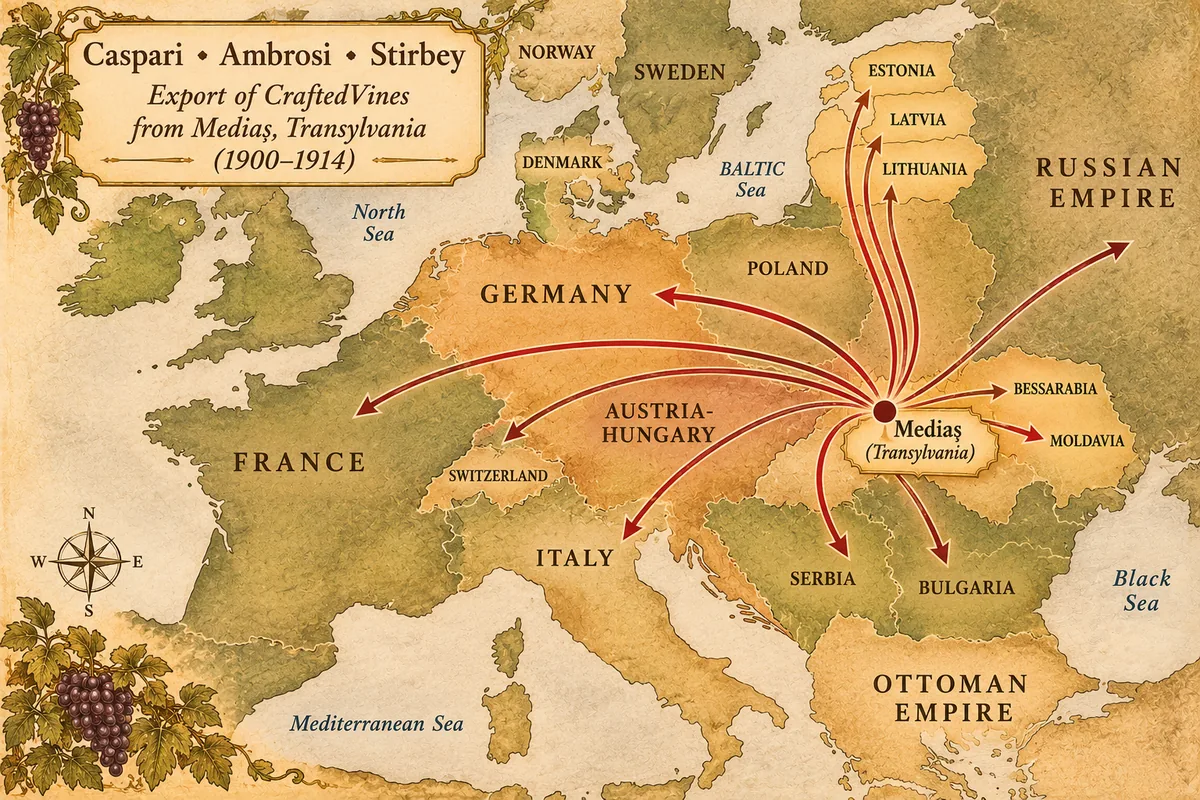
The second part of the system was storage. Ambrosi held Transylvania's wine logistics depots at Mediaș, sited there because the town had a railway, and the railway was then the principal means of transport. Here the wine that went to the markets of the kingdom and the monarchy was gathered, held and prepared for dispatch. The paperwork of that circuit survives: the envelope “Viile și Pivnițele Ambrosi, Mediaș”, the labels Ambrosi Imperial and Ambrosi Privat, the expert report and the house catalogue. They show a business that thought in seasons, in wagons and in stock.
At Crăciunel, Michael Ambrosi sen. held seventy hectares, an area on a different scale from the vineyard at Mediaș. After nationalisation this land became the basis of today's Viticulture and Vinification Research and Development Station at Blaj — a rare continuity: the land remained a vineyard even when the name on the deeds changed. Alfred Ambrosi took over the Crăciunel estates in 1927 and worked there with his own rootstock, “Ambrosi-special”, which he selected and propagated.
Today the documents can be read, visits arranged and the route between hill, depot and station reconstructed. The land is mostly working land or outside public access, and the cellar does not operate as a museum: visits are by arrangement through contact.